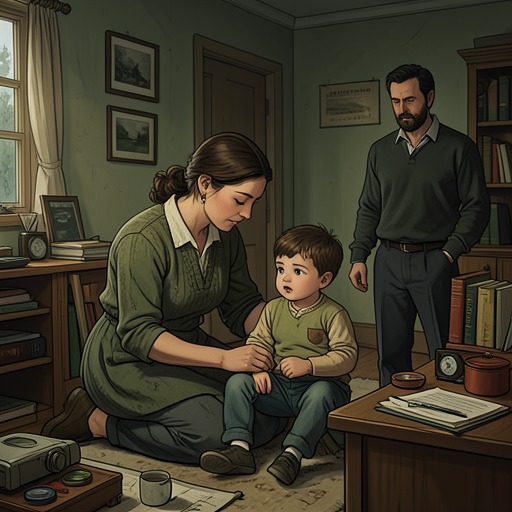
Celia Favreau’s mother-daughter relationship with Ginny
All the Old KnivesCelia Favreau’s relationship with her daughter, Ginny Favreau, is presented through a stark contrast: the helplessness of a child caught in public violence and the ordinary domestic care that follows. Aboard the hijacked Flight 127, Celia draws Ginny close and tries to make her own body and voice into protection. In the quieter life that follows, the same maternal responsibility shapes Celia’s decisions, her attention to Ginny’s needs, and her determination to remain alive and present for her children.
Protection aboard Flight 127
The clearest expression of Celia’s bond with Ginny comes after a hijacker stands and shoots a stewardess through the chest. The passengers have just watched the woman, who had served drinks and shown kindness to Ginny and Evan Favreau, fall to the floor. Amid the shock, Celia does not join the screamers. She recognizes that she has a responsibility to her children and turns toward them when Evan asks what has happened and Ginny jerks in her lap and starts crying.
Celia brings both children’s faces close and tells them to stay in their seats and remain quiet: a bad man is on the plane, and he will hurt them if they get up. The instruction is simple, concrete, and directed at what the children can do in immediate danger. Ginny and Evan grab at their mother, pulling closer in a gesture Celia understands as an attempt to climb back into the womb. She squeezes them as if she could hide them there, where safety might still be found. The embrace cannot remove the danger, but it gives the children someone to cling to and a clear instruction to follow.
Her promise to Ginny and Evan is equally direct: “Everything will be all right. Okay? Mommy won’t let anything happen to you. Okay?” The assurance exceeds what Celia can know or control; its force lies in her taking responsibility for their safety while violence unfolds around them. Her voice stops Ginny’s crying, though Ginny’s eyes continue streaming and both children cry silently. Celia’s own eyes, by contrast, have become achingly dry. The scene shows maternal composure not as freedom from fear, but as the effort to keep fear from displacing the children’s immediate need for guidance and comfort.
Care in the aftermath
The relationship is also situated in the children’s ordinary routines, which the narrative places beside the memory of crisis. At home, Celia answers a call from Bill Compton and then hears Ginny call “Mommy.” She gets up and goes to Ginny’s room, where her daughter, not quite two, is sitting up in a white IKEA bed with raised sides. Ginny’s hair is tangled across her damp face, and she is sniffing quietly after a bad dream. The scene gives the maternal bond a different scale from the aircraft emergency: no public violence is taking place, but Ginny’s distress still summons Celia out of an adult conversation and into the child’s room.
The passage does not say that this nightmare is caused by the hijacking, and it does not assign Ginny an understanding of her mother’s past. Instead, it shows Celia responding to the need in front of her. The movement from a tense telephone call to the bedroom makes care a recurring, practical act: Ginny calls, and Celia goes to her. The small detail of the raised sides of the bed also locates Ginny as a very young child who depends on adults for safety in everyday surroundings, not only during exceptional danger.
A later morning scene places Ginny within the household’s familiar pattern. Celia scrambles eggs and looks out at the garden while Evan Favreau plays Angry Birds on an iPod and Ginny eats toast spread with peanut butter. Celia has feared that Ginny might be sick, but Ginny does not seem ill. Getting both children dressed becomes a welcome distraction from Bill Compton’s call. These domestic details do not erase the danger Celia has known; they show the repetitive labor of looking after her children continuing alongside her adult concerns.
Motherhood as a continuing responsibility
Celia makes the wider meaning of motherhood explicit while deciding whether to respond to Henry Pelham. At the Carmel Academy of Performing Arts, while Evan is inside taking ballet lessons and Ginny is with Consuela at My Museum, Celia has forty-five minutes to make up her mind. She has Henry’s unanswered email and Karl Stein’s card, and she has sought Bill Compton’s advice. Bill tells her not to meet Henry under any circumstances. Celia understands his wish to avoid further conflict, but she distinguishes her situation from his: he is retired and wants peace, whereas she has children.
For Celia, having children changes the terms of self-preservation. Life begins again with an imperative to protect them, and caring for her health and welfare becomes a way to remain available to them for as long as possible. A quick escape is therefore no solution in her reasoning: problems must be confronted and threats neutralized. She hesitates because she depends on the quiet and calm of her life, but she believes that withdrawing will not keep Henry away; she fears he will follow her and threaten what she has built. The choice is not presented as a wish to return to danger. It grows from her sense that protecting her children requires dealing with a threat rather than hoping distance will make it disappear.
That responsibility also shapes how Celia understands endurance. Recalling the night she is recounting to Henry, she knows she will carry it for the rest of her life and expects memories to return while she puts Ginny to bed or watches Evan’s ballet recitals. Her task, as she frames it, is to keep the memory from suffocating her; the children force her to keep going. Ginny’s bedtime and Evan’s performances mark the future in ordinary, recurring scenes, not as proof that the past has vanished but as obligations that continue despite it. The relationship therefore links immediate protection to long-term persistence: Celia cannot promise control over every danger, but she organizes her choices around being there for Ginny and Evan.